
Resource Page
Quick answers to the questions that come up repeatedly in product and scheme conversations.
Common Questions
Click a question to reveal the answer.
Product Selection
NCLD (60kg, 2m) is the standard cycle lane defender for permanent installations on lower-speed streets. NCLD Lite (24kg, 1m) is lighter and shorter, suited to trials, tight corners and single-installer handling. Lane Separators (95–105kg) are the heavy-duty option for high-speed roads and heavy traffic where greater impact resistance is needed.
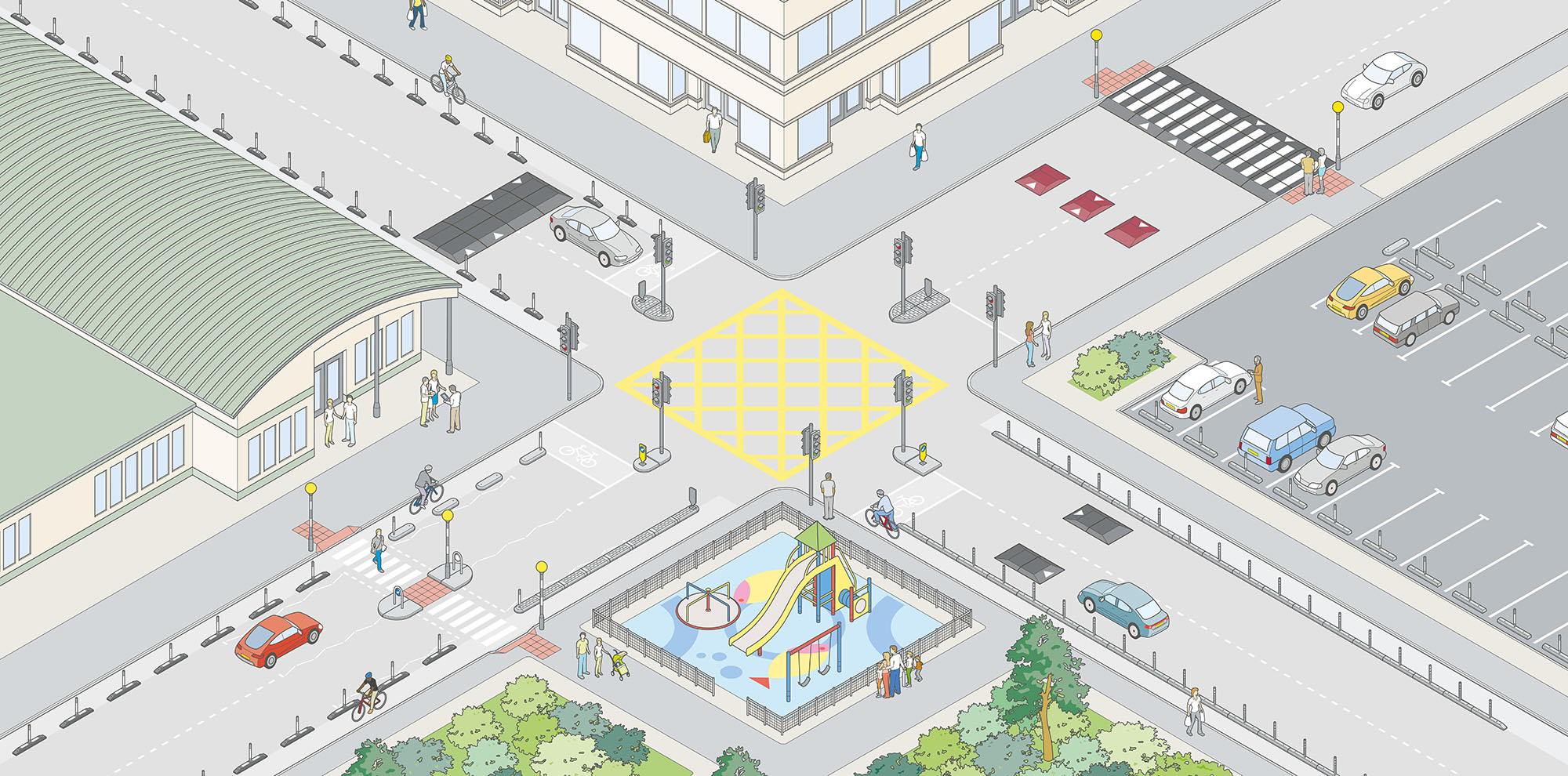
Speed cushions provide vertical deflection for speed reduction on residential streets and can be straddled by buses. Speed calmers have a longer, gentler profile for environments where driver comfort matters, such as car parks and airports. Raised tables combine speed reduction with a defined pedestrian crossing point.
Traffic islands are used for junction channelisation, chicanes and general traffic management. Pedestrian refuges are specifically designed as safe midpoint crossing islands, with optional tactile paving and solar-powered beacons for pedestrian accessibility.
Yes. Products are frequently combined — for example, NCLD defenders with traffic islands on cycle corridor schemes, or speed cushions with raised table crossings on residential streets. Our team can advise on the right combination for your layout.
The Nike Grind range is a premium version of our cycle lane protection products (NCLD, NCLD Lite and Lane Separators) that incorporates Nike Grind rubber from manufacturing scrap alongside recycled tyre rubber. It is suited to schemes where material specification, appearance and ingredient transparency are priorities.
Cycle Lane Protection
All NCLD products (standard, Lite and Lane Separators) provide 130mm kerb-height separation between vehicles and cyclists.
Yes. All cycle lane protection products are surface-mounted and can be removed and repositioned. NCLD Lite is particularly well suited to trials due to its lighter weight and single-installer handling.
Yes. Lane Separators are the heaviest units in the cycle protection range at 95–105kg each, designed specifically for roads with faster speed limits and heavier traffic where a more substantial physical barrier is required.
NCLD units support optional 50mm retroreflective glass eyes. NCLD Lite includes a retroreflective glass eye as standard, plus an M24 anchor thread for bollard mounting. All products are compatible with a range of keep-left signs and reflective bollards.
Speed Calming
Yes. All Rosehill speed cushions conform to Department for Transport and UK council specifications for road humps. They are available in 65mm and 75mm heights in black or red.
Yes. The cushion profile (1,650mm width) is designed so that buses and emergency vehicles can straddle the cushion with reduced deflection, maintaining response times and service routes.
Yes. Speed calmers are widely used in supermarket car parks, logistics depots, hospital parking, airport access roads and business parks. Their longer, gentler profile is designed for environments where driver comfort and cargo protection matter.
Yes. All speed calming products are surface-mounted with adhesive and bolts. They can be removed before resurfacing and reinstalled afterwards.
Traffic Islands & Crossings
One-piece islands (up to 2m) install in under 30 minutes. Two-piece islands (up to 2.4m) install in under 40 minutes. No excavation is required.
Yes. Tactile paving tiles (400 × 400mm, buff) are available as an accessory and can be surface-mounted directly onto the refuge island. An optional cable-less solar-powered beacon is also available.
Yes. All island types can be extended in both length and width using extension pieces, allowing bespoke geometry for chicanes, junction channelisation or unusual site layouts.
Yes. The DI-1200H traffic island is available with a heritage block paver surface pattern for installations in conservation areas or sensitive streetscapes.
General
Yes. All products are manufactured from 100% recycled tyre rubber at our facility in West Yorkshire. This supports circular economy targets without compromising on durability or performance.
Rosehill Highways is based at Spring Bank Mills, Sowerby Bridge, West Yorkshire, HX6 3BW. All products are manufactured at this facility. Get in touch.
Yes. We deliver practical CPD seminars for local authorities, consultants and contractor teams covering cycle lane protection, speed calming and traffic island specification. Sessions can be delivered remotely, at your offices, or at an alternative venue. Book a CPD session.
Send your question with some scheme context and we'll provide a tailored response.